


SuperTruck II boasts enhanced efficiency
发布时间:21 August 2023浏览量:908
Navistar has announced its collaboration with the United States.EnergyDepartment of Energy (DOE) collaborative international supercomputing initiativelorry II Project Outcomes. International SuperTruck II achieved 16 mpg fuel efficiency through hybrid technology.efficiencyFreight efficiency has increased by 170%, with further improvements compared to the 2009 benchmark vehicle, the International SuperTruck I.
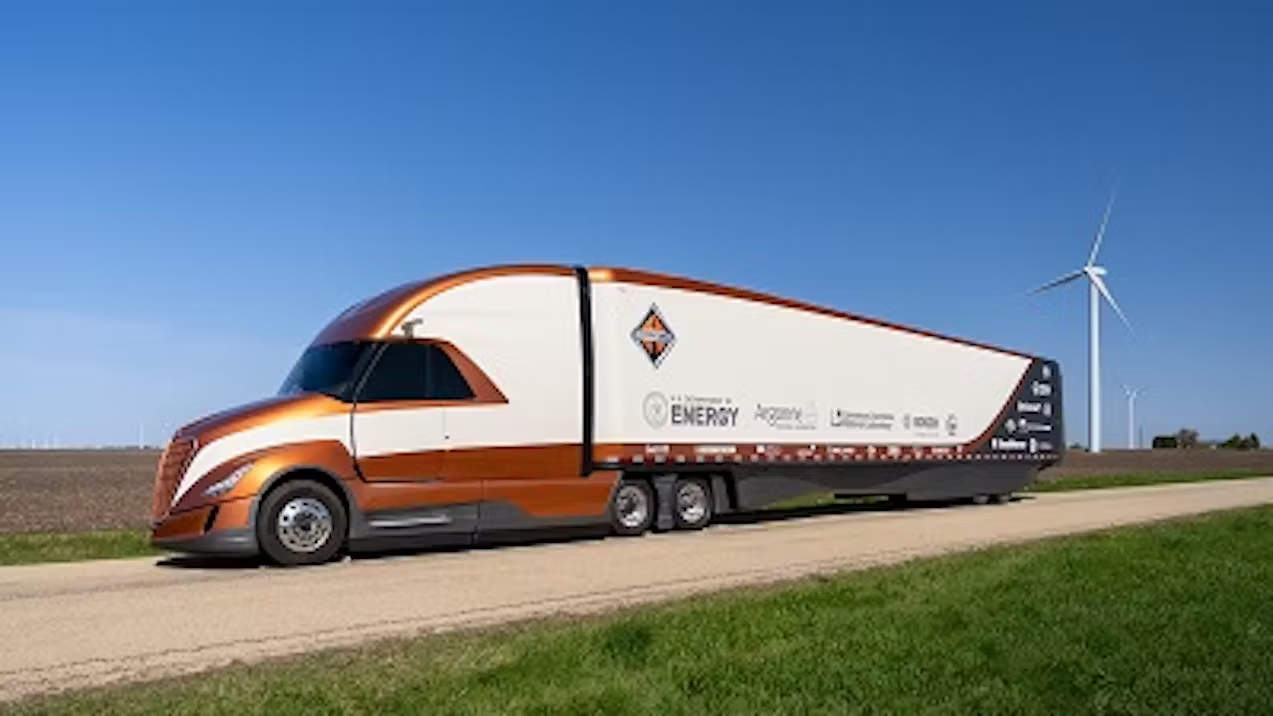
It also demonstrates innovative technical approaches to weight reduction through rolling resistance technology, aerodynamic enhancements and powertrain engineering, designed to deliver superior freight efficiency and help reduce dependence on fossil fuels within the American commercial vehicle sector.
“With co-funding from the US Department of Energy, Navistar engineers have pioneered forward-looking technologies not yet available in the current Class 8 truck market to accelerate the impact of sustainable transport,” stated Russ Zukouski, Chief Researcher and Global Chief Engineer for Innovation on the Super Truck programme, in a press release. “The team has focused its design efforts on high-voltage systems."ElectrificationAbove, achieving full electrification through hybrid technology, which holds the potential to surpass pureelectric vehicleAchieve commercialisation and improve customers” total cost of ownership (TCO) and business operations.”
The International Super Truck II programme aims to enhance Class 8 vehicle efficiency and reduce US dependence on fossil fuels, focusing on improving next-generation vehicle efficiency through hybrid and aerodynamic technologies. Results indicate a 170% improvement in vehicle freight efficiency and a 55% increase in engine braking thermal efficiency. The project assessed total cost of ownership (TCO) opportunities for various technologies and modelled high-voltage electrification work for hybrid technologies applicable to fully electric vehicles.
“Navistar is the only OEM manufacturing trailers to deliver the most accurate test results,” stated Dean Oppermann, Chief Engineer at Advanced Truck. “This includes a 100% composite box designed for minimal aerodynamic drag, lightweight construction, integrated cross-members, controlled underbody flow with composite aerodynamic treatment, and next-generation connectivity options."Solar energyBatteryThe control panel and ride height adjustment.”
The International SuperTruck II is a hybrid vehicle featuring an internal combustion engine developed in collaboration with Bosch, incorporating high-voltage components and technology, underscoring Navistar's commitment to an electrified future. The engine features enhancements in critical areas including combustion, friction, gas exchange, and engine airflow. Compared to the International SuperTruck I, the redesigned cylinder head incorporates a dual overhead camshaft engine and an enhanced fuel system, delivering a 21% improvement in fuel economy. Upgrades to the aftertreatment system include:dieselDeNOx fluid (DEF) dosage, enhanced blending and reduced limits, alongside new selective catalytic reduction (SCR) formulations, enable substantial nitrogen oxide reductions and shorten cold start activation times.
“A comprehensive systems approach is required to achieve the 55.21 TP3T braking thermal efficiency,” stated Jim Cigler, Senior Chief Engineer for Engines. “Internal engineering teams collaborated with research...PartnersArgonne National Laboratory identified opportunities through detailed analysis and simulation. System suppliers such as Bosch, Jacobs Vehicle Systems and Applied Nano Systems (ANS) introduced novel approaches to critical systems, enabling the laboratory's success and enhancing real-world fuel economy. Navistar has been able to discover new methods to elevate our engine efficiency to unprecedented levels.”
International SuperTruck II emphasises connectivity with next-generation predictive cruise control, alongside leveraging technology and information across the broader Traton Group to explore vehicle-to-everything technology for enhanced safety and vehicle efficiency.
Opman stated: “Our objective is to continue advancing internal combustion engine technology as efficiently and sustainably as possible until it is on par with zero-emission vehicles.” “Developing both technologies in parallel ensures a smooth technological transition that best meets customer needs. We focus on the entire product ecosystem – the product development itself, alongside infrastructure charging, services and support for vehicle operation, and battery end-of-life management.”