


Sustainable development is not merely a buzzword.
发布时间:21 August 2023浏览量:1007
“SustainabilityThis term has largely become popular in the 21st century, appearing almost everywhere nowadays.construction industry(though it may seem rather old-fashioned) is no exception.
But in the steel world, is it merely a case of “Look at us!”? Is it window-dressing to attract investors and environmentalists, avoiding the wrath of green-leaning politicians, or is it genuine?
In addition to the extra initial costs, this isConvoyWhat's the point?
This may depend on the objectives of individual teams and the priority they place on reducing emissions and carbon footprints. In the long term,dieselIt will certainly save money.
Take a look at some original equipmentmanufacturerfleet and equipment hire providers, who are operating under the principles of environmental and social governance andSustainable Developmentin the name of [the cause], numerous concrete steps have been taken.
Construction equipmentHow can sustainable development be achieved?
In terms of OEMs, John Deere is a company that has specifically formulated 2022 sustainability targets for its products. They are reducing the environmental impact of new 90% products, including carbon dioxide emissions; by incorporating remanufacturing and rebuildingsales revenueIncrease the use of sustainable materials by adding 30%; and incorporate more recyclable, renewable and reusable content.
More specifically, in the construction sector, Deere has established partnerships with electricity, gas and clean energy providers in the northeastern United States.EnergyThe conveying company has partnered with State Grid to develop backhoe loaders.Solutionsto support its sustainable development goals in achieving carbon neutrality.
E-Power BackhoeLoaderis a fully integrated system developed based on the current 310L backhoe loader.BatteryPrototype, equivalent to a 100-horsepower diesel engine.
Previously at Deere HybridElectric wheel loaderThe company's accumulated product experience enabled it to select and integrate the electric drive system for its first battery-powered backhoe prototype. Deere adopted a phased approach, prioritising the development of critical systems and accelerating collaborative testing with the State Grid.
E-Power BackhoeexcavatorThe initial phase was designed by Deere, utilising client feedback and the expertise of corporate technical specialists to help accelerate the team's progress on battery systems, battery charging strategies, andElectrificationKnowledge of auxiliary components.
The next phase of this project will incorporate feedback from State Grid's testing and build upon the experience gained in the initial stage to increase operational uptime and maximise the experience for backhoe operators.
Deere backhoe loader product manager Brian Hennings stated that the E-Power system and its power source are projected to reduce carbon dioxide emissions by up to 83 tonnes over the product's lifetime, whilst also conserving over 7,300 gallons of diesel fuel. Being fully electric also means it operates more quietly, currently reducing diesel decibel levels from the noise of a kitchen mixer to that of a tumble dryer.
“This creates a safer working environment,” said Jon Gilbeck, Production Systems - Field Development and Underground Manager. “Communication is key between operators and other support personnel. It also causes less disruption to the community or nearby businesses.”
Henning said: “Our objective is to achieve performance and controllability in fully electric backhoe loaders comparable to diesel-powered models.”
Currently in the first phase of proof-of-concept, the E-Power backhoe loader is being deployed in real-world operational settings. Henning stated that should further testing proceed successfully, the battery-electric solution could enter commercial application within a few years.
However, Gilbeck stated that the benefit of utilising E-Power backhoe equipment on-site was “fostering productive dialogue with customers across all production systems,” which helped Deere gain broader perspective and prioritise future investments.
Deere stated that insights gained from its E-Power backhoe loaders across multiple product lines are expected to pave the way for a greener earthmoving fleet, encompassing not only backhoe loaders but also up to five or six distinct fully electrified machine variants.
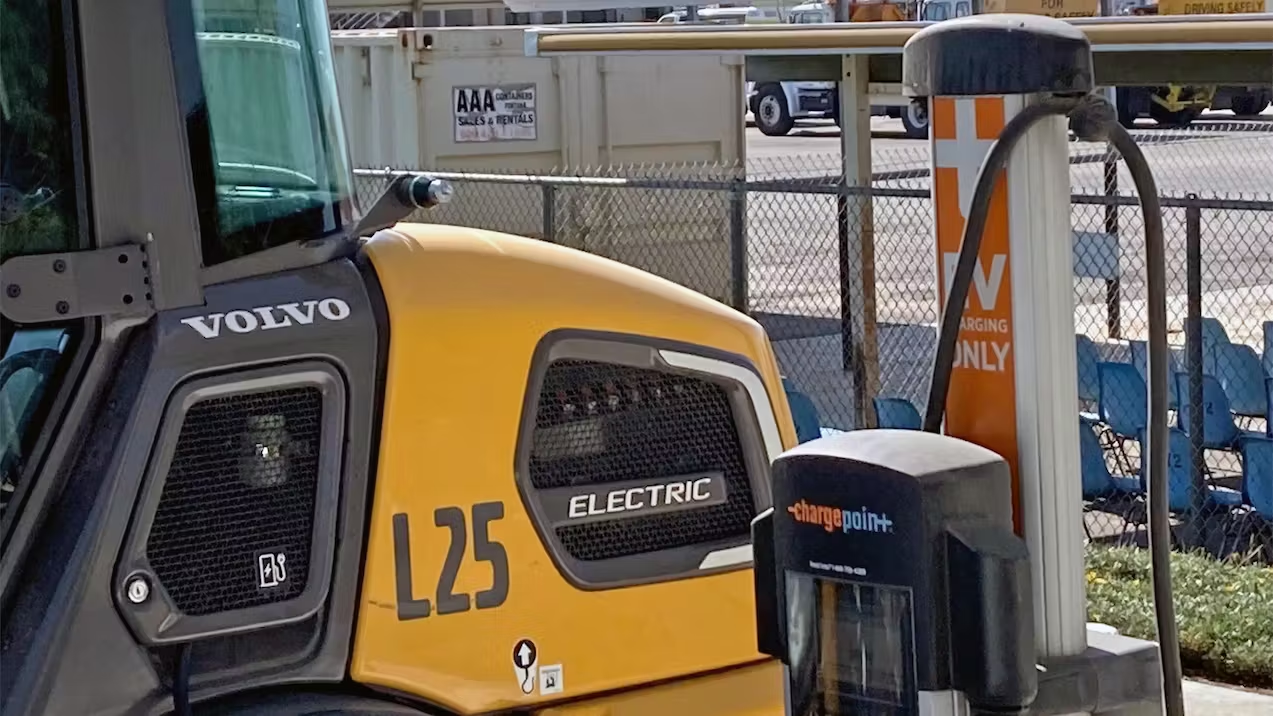
VolvoThe construction equipment company has already sold five electric motors in North America, and its marketing campaign for electric motors and hydrogen fuel cell testing has swept across the entire region.Industry。
These are by no means the only two companies pursuing hybrid technology, electrification and fuel cell research.
How does the equipment manager view the motor?
Fleet managers are generally open to the possibilities of electrification, though many remain uncertain about how to proceed.
Ben Tucker, CEM, Equipment and Facilities Director at Barriere Construction in Metairie, Louisiana, posed more questions than answers when queried about electrical equipment.
“Personally, I find this a bit nerve-wracking, especially if you're running a 24-hour operation,” he said. “When on earth do you find time to charge the thing? Because you'd need an extra unit [for the charging equipment]. Or perhaps you'd face a situation like Texas, where the entire grid goes down when the freezing weather hits. What then?
“JustefficiencyAs for running, if you stick to the set schedule, I believe it can be achieved,” Tucker said.
“Where and how will we integrate this [technology]?” Tucker remarked. “Believe it or not, I reckon it'll enhance safety too, since every workplace will have some sort of power station to charge these things. Are you planning to run generators for everything? Would that mean disconnecting from the grid? Perhaps—"Solar energyThe technology will emerge. But if it operates during the day, how will it be charged at night?”
David Bolderoff, CEM, Fleet Manager for the Los Angeles County Health District's Fleet Management and Transportation Department, has been an advocate for alternative fuels and electrification since at least 2015. He suggests that leasing could serve as a good starting point for fleets seeking electric vehicles.
In fact, the rental industry has become a more significant equipment provider, particularly as managers grapple with delays in the delivery of new equipment today. Sunbelt (Bobcat) and United Rentals (TakeuchiLeasing companies such as [company names] have partnered with original equipment manufacturers to develop electric, zero-emission equipment.
“Aslynx Sunbelt Rentals' bulk purchase of CTLs demonstrates that electric vehicles are also viable. For smaller items, I might simply plug it into a standard 100-volt socket without requiring a dedicated charging point.charger”Bolderoff said. “But companies like Sunbelt are addressing the machine's charging issue; if you need it for more than a day, they'll provide you with the machine's charger."
“The rental company can collect it at the end of the day and handle the charging themselves,” said Bolderov. “I believe this is entirely feasible for compact machines; I think it would be more challenging with larger equipment.”
He also suggested initially trialling the roadside approach with light machinery and fleets.
“I believe the simplest stepping stones and what we've done is to get your feet wet in the lighter aspects,” said Bolderoff. “Installing charging infrastructure is a challenge; every project is slightly different, particularly if you're going underground to install the infrastructure. Costs can vary significantly depending on where you source your electricity from."
“FordManufacturers such as General Motors have already announced plans to launch electric pick-up trucks, so most fleets possess substantial pick-up inventories to support their operations,” said Bolderoff. “Perhaps the first step is to equip some fleets with pick-ups, install charging infrastructure there, and then identify solutions for keeping road fleets powered,” Bolderoff added. “Then you can explore whether there are any heavy-duty..."lorryYou may also utilise the infrastructure there for pilot schemes.”
Bolderoff recommends that the team display compact electric equipment such as mini excavators, wheel loaders or CTLs, or hire one from a local rental company.
“Observe how it operates, gather feedback from the operators, and ascertain what they find satisfactory and unsatisfactory,” said Bolderoff. “Unless we provide the original equipment manufacturers with constructive feedback, they don't always receive the necessary insights. Therefore, I believe it's crucial that we entrust these devices to our operators or technicians, allowing them to test them, witness the technology in action, and subsequently relay their feedback to the manufacturers."
“When they expand these product lines, if more people see what they offer and provide feedback, they can avoid certain issues,” said Bolderoff. “Original equipment manufacturers are waiting for us to demonstrate this demand; they need us to show there's a need for it and prove it's a requirement within the industry.”
With larger contractors, discussions on sustainability inevitably become more corporate in nature.
Global contractor Bechtel has stated its commitment to achieving net-zero emissions by 2050 and is currently developing interim targets aligned with the findings of the United Nations Intergovernmental Panel on Climate Change. The aim is to first reduce emissions (rather than offset them), then remove carbon to offset any residual emissions as the target approaches.
The company acknowledges that,electric vehicleIt has been around for some time, but its adoption rate has remained too low to attract significant investment and meaningfully replace the internal combustion engine (ICE).
However, Burkhard has now recognised that electric vehicles are replacing a significant portion of the traditional internal combustion engine vehicle market, presenting intriguing opportunities.
In the coming years, a wave of electric vehicles will flood the market, leading to significant growth in this sector. However, substantial investment in charging infrastructure is required to support this expansion, and the company has already taken action.
Despite significant investment by car manufacturers in developing battery-powered models, consumers remain reluctant to purchase them without adequate charging infrastructure to support these vehicles. Indeed, the scarcity of electric vehicle charging stations is frequently cited as a major barrier for consumers considering the transition from internal combustion engine vehicles to electric ones.
Across the globe, particularly in Europe and China, substantial investments and policy measures are being implemented to address the lack of electric vehicle infrastructure. However, North America generally lags behind in this regard. The International Council on Clean Transportation recently reported that 88 of the top 100 metropolitan areas in the United States possess insufficient charging infrastructure to support even half the total charging capacity required for the electric vehicles projected to be on the roads by 2025.
charging infrastructure
Barked stated that in order to prepare for the future of electric vehicles within the next three to five years, the company must adopt a long-term perspective and undertake large-scale construction of critical charging infrastructure across North America.
Barked and General Motors are collaborating to establish a large-scale direct current (DC)Rapid chargingNetwork.
“At Buckle, we believe electric vehicle charging presents an exceptionally compelling opportunity for our company, as it combines our three traditional markets—power, transport and communications infrastructure—and embodies our very definition: building significant large-scale projects,” said Kelly Brown, Global Communications Director for Buckle Infrastructure and Power.
“Our aim is to establish a large-scale charging network across North America, so that ‘range anxiety’ – the fear of being unable to find a charging station – ceases to be a barrier to purchasing electric vehicles,” said Brown. “We believe in a clean future and consider this one of many significant steps towards that goal.”
Leasing companies also wish to receive and provide feedback. United Rentals has recently completed a series of pilot programmes for new electrical equipment and now offers electric and hybrid machinery to help reduce emissions and energy costs.
Electric or hybrid vehicles account for approximately 20% of its rental fleet. Categories include electric forklifts, aerial work platforms, skid steer loaders and compact excavators, solar-powered tow lights and LED lights.
The company stated that it maintains regular communication with clients and original equipment manufacturers to discuss industry trends, evolving requirements, and future equipment offerings. It evaluates new products upon their market introduction to help fulfil client needs and provide them with the most innovative, sustainable, and efficient equipment available within the sector.